
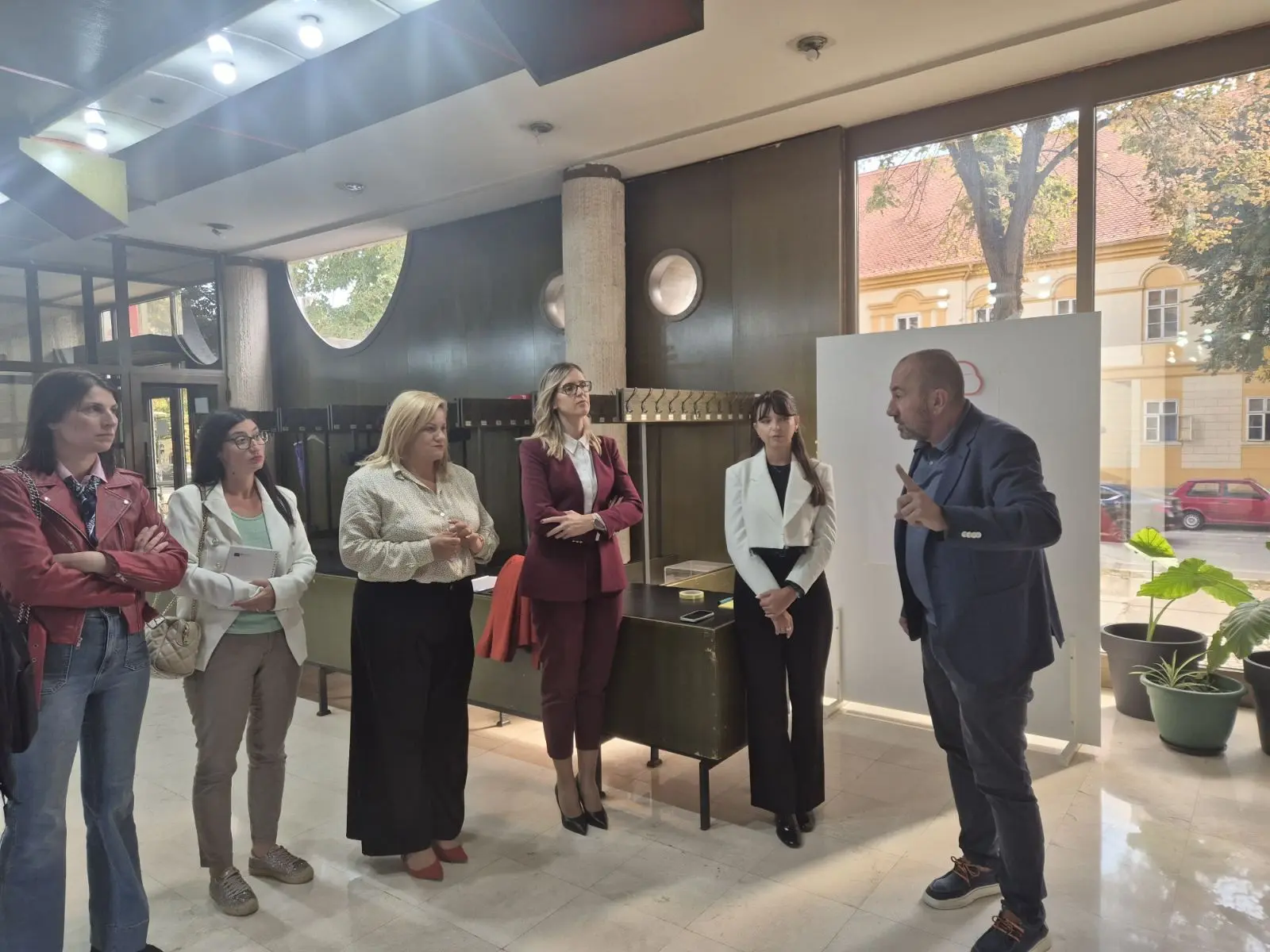
Connecting the development potential of seven local self-governments and exploring opportunities to contribute to the sustainable development of the entire Srem region through joint initiatives were the focus of the Public Forum held in Sremska Mitrovica as part of the preparation of the Territorial Strategy for the urban area of the City of Sremska Mitrovica and the municipalities of Ruma, Stara Pazova, Irig, Pećinci, Šid and Inđija. The Forum brought together representatives of local self-governments, the Srem Regional Development Agency as a partner in the preparation of the Strategy, institutions, and the community.
The development of the Territorial Strategy is supported by the European Union through the EU Support to Integrated Territorial Development Programme – EU INTEGRA, implemented in cooperation with the Ministry of European Integration. The Programme is implemented by the Standing Conference of Towns and Municipalities (SCTM) and the United Nations Office for Project Services (UNOPS). Under the component implemented by UNOPS, ten territories have received support to prepare territorial strategies and develop capacities for applying integrated territorial development instruments in line with the European Union’s Cohesion Policy.
Deputy Mayor of Sremska Mitrovica Danica Nedić noted that the Strategy provides an opportunity to consider Srem’s development through what connects its local self-governments and people.
“For us, it is important that development reflects people’s needs and that we create conditions that encourage them to stay, work and raise their families here. The Strategy enables us to better connect what our territory has to offer, and that is its economic and agricultural potential, natural and cultural heritage, and opportunities to develop a joint and more recognisable tourism offer. By connecting these assets more effectively, we can create new economic opportunities and contribute to a better quality of life throughout our territory,” Nedić said.
Milica Ralević, representative of the Ministry of European Integration, said that the Ministry is working to develop a national system for managing integrated territorial development and applying territorial instruments.
“Territorial strategies allow development needs and opportunities to be considered beyond municipal boundaries and turned into shared priorities and concrete project ideas. This is particularly important for an area that covers the entire Srem District and brings together seven local governments. By planning together, they can make better use of their combined potential and respond more effectively to common challenges. The process also strengthens local capacity and helps ensure that shared priorities can be translated into concrete interventions and investments in the coming period,” Ralević said.
“Following an analysis of the current situation, proposed objectives and measures were defined through thematic discussions with local stakeholders, while the Public Forum provided an opportunity for a broader group of participants to review and supplement them. This participatory and integrated approach is particularly important for territories comprising several local self-governments, as it ensures that the Strategy is based on the experience and proposals of those who know the territory best and will take part in its implementation,” said Viktor Veljović, Capacity Development Manager for the UNOPS-led component of the EU INTEGRA Programme. He recalled that EU INTEGRA builds on the results of the EU PRO Plus Programme, through which this approach was piloted.
A special part of the Forum was dedicated to pupils from the Sveti Sava and Jovan Popović primary schools in Sremska Mitrovica, who used the “My City in the Future” art competition to show how they imagine the community in which they would like to grow up and live. Their works were displayed during the Forum, and participants voted for the three entries that made the strongest impression on them, whose authors received awards.


